
Need help? Call us:
+91 95600 78750
+91 95600 78750
📞
Discover fun Friday activities for employees, from trivia and Human Bingo to useful tech rewards that keep teams engaged. The real question is not whether Friday needs a break — it’s which activity actually gets people talking, laughing, and paying attention without turning the afternoon into a production.
Quick Highlights
A one-hour Friday session can reset the mood, and the strongest version of Fun Friday activities for employees is usually the one that ends with something useful, not just a game people forget by Monday. That’s where the balance matters. You want a little energy, a little connection, and just enough structure to keep things moving without making it feel like another meeting.
Look, most teams don’t need a huge office event to feel better at the end of the week. They need something easy to join, easy to understand, and actually worth showing up for. When you get that mix right, even a small activity can shift the whole vibe of the day.

The article argues that Friday works best when the activity is small, low-friction, and easy to finish in about an hour. It doesn’t need a party budget or a half-day out of the office to change the tone of the week. In fact, the lighter it feels, the more likely people are to participate without dragging their feet.
That matters because the raw content keeps returning to the same point: simple formats often beat complicated ones, and the best examples include teamwork, conversation, and a quick reset after a busy week. People are already tired by Friday. So if the activity needs a long explanation, a lot of materials, or a big emotional lift, it’s probably not the right fit.
Here’s the thing: a short format lowers the barrier. Employees don’t have to prep, dress up, clear their calendars, or mentally brace for a big event. They can just show up, join in, and move on with the day feeling a little more connected than before.

Activities like Two Truths and a Lie and Human Bingo push employees into conversations they would not normally have. A finance employee ends up talking with someone from marketing, or a new hire gets a relaxed moment with senior team members.
That sounds small, but it’s the kind of small that matters in real workplaces.
That same logic shows up in the company examples too: the piece treats useful engagement as something that improves communication, not just entertainment.
When people laugh together or discover a surprising detail about a coworker, the interaction sticks a little longer. It’s not magic. It’s just how trust tends to build in everyday office life.
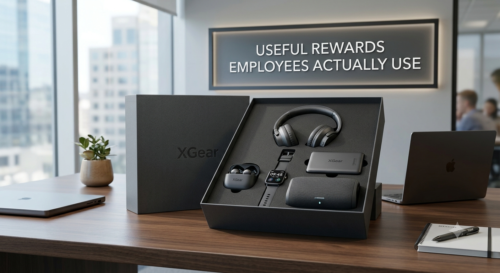
The article keeps XGear’s angle in view: useful gifts work better than generic ones. The strongest reward ideas are earbuds, smartwatches, power banks, and speakers — items employees can actually use after Friday ends. That’s the difference between a reward that feels thoughtful and one that feels like leftover stock from a drawer somewhere.
It also frames corporate gifting as practical, especially for larger orders where products, quantity, budget, and billing all need to line up. For HR teams, that’s not a small detail. A reward system only feels smooth when the logistics are smooth too, and that’s what makes the whole thing sustainable instead of annoying.
The games section is built around easy setup, clear rules, and enough room for teams to compete without needing much explanation. The activities are simple because the point is participation, not performance. Nobody wants to spend ten minutes listening to the rules for a game that’s supposed to be fun.
Several of the examples are deliberately fast: a 15-minute gadget game, a quiz, a guessing round, or a challenge that works with a small group and minimal prep. That pace is important. It keeps the energy light and helps the session feel like a reset instead of another task on the calendar.
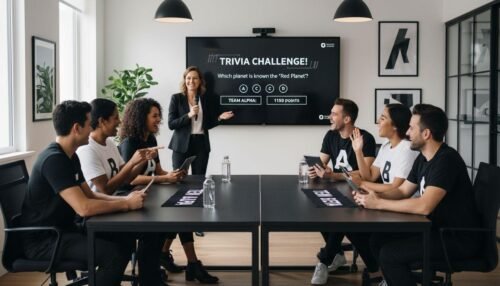
What’s nice about these games is that they don’t need a special personality type to work. Quiet people can still shine in trivia. Extroverts usually enjoy the guessing games. And mixed groups often end up surprising themselves because the format is playful without being awkward.
Human Bingo is the clearest fit when departments do not interact much. The card examples include travelling to another country, playing an instrument, having a pet, loving gaming, working at the company for more than five years, and speaking more than two languages. It’s basically a conversation starter disguised as a game, which is why it works so well.
Team Role Switch, Friday Debate, and Office Meme Challenge do a different kind of work: they make people explain roles, argue light topics like work from home or office and tea or coffee, or turn workplace moments into memes without making anyone the target. That last part matters. The humor should feel shared, not pointed.
Now, if you’ve ever watched a new team go awkwardly quiet in a meeting, you already know why this matters. A game that gently opens people up can do more than a dozen “icebreaker” emails ever will.
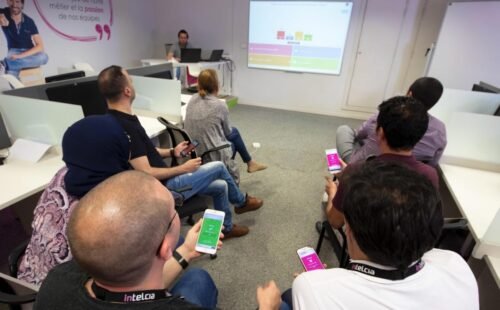
The tech games are not there just to sound modern. They fit the workplace because employees already spend so much time around smartphones, gadgets, apps, and everyday technology. That makes the whole session feel a little more relevant right away. People don’t have to pretend this is some separate world from their actual jobs.
They also connect naturally to the reward ideas later in the article, which is why the naming and the product examples matter instead of feeling decorative. When the activity and the reward echo each other, the whole thing feels more intentional. That’s a small detail, but it changes how polished the experience feels.
 The Friday tech quiz uses questions like “What does ANC stand for in earbuds?”, “Which device is commonly used to provide backup power to a smartphone?”, “What does AMOLED refer to?”, and “Which technology is commonly used for wireless audio connections?” It’s the kind of quiz that feels familiar without being too easy.
Guess the Gadget is the quicker visual version: employees identify products from close-up shots or partial views like a charging port, earbud case, speaker button, smartwatch display, or cable connector. The article says it can fit into a 15-minute slot before the team moves on. That short timing is part of the appeal. It gives people a quick burst of curiosity and then gets out of the way.
And honestly, that’s a smart rhythm for Fridays. A little challenge, a little fun, and then back to your day with a better mood than you started with.
Not every activity needs a full session. The examples here are short on purpose: stacking five cups in one minute, naming 10 smartphone brands in one minute, moving as many balls as possible using a spoon, naming 15 movies without repeating one, or building the tallest paper structure in one minute.
That smaller scale is part of the article’s rhythm — a few quick games, then a shift back to work instead of trying to force a big event. It’s a nice reminder that morale doesn’t always need a grand plan. Sometimes it just needs a little interruption in the usual routine.
If your team is overloaded already, these mini challenges are probably the safest place to start. They feel doable, which means people are more likely to actually join instead of politely watching from the sidelines.
The planning section is less about games and more about making the program sustainable. The article argues for a simple rotation instead of escalating the event every week. That matters because once a good idea becomes an exhausting obligation, people stop enjoying it and start resenting it.
It also widens the frame beyond the office, because remote and hybrid teams still need a version of the same experience. The setting changes, sure, but the need for connection doesn’t disappear just because people are on different screens.
| Week | Focus | Examples |
|---|---|---|
| Week 1 | Games | Two Truths and a Lie, Pictionary, Charades |
| Week 2 | Team Challenge | Paper Tower, Scavenger Hunt, Mystery Box |
| Week 3 | Knowledge | Trivia, Tech Quiz, Guess the Gadget |
| Week 4 | Recognition | Team games followed by small employee rewards |
The underlying point is simple: the format can repeat if the mix changes. That keeps HR workload manageable while avoiding the feeling that every Friday has to be bigger than the last. And that’s a relief, because consistency is usually more valuable than novelty when you’re trying to build culture.
That list matters because it shows the article is not office-only. It keeps the social piece intact even when the team is not physically together. In a lot of ways, the format is even more important for remote teams because casual conversation doesn’t happen as naturally.
And if you’re trying to make this work across locations, keep it simple. The more everyone can participate without confusion, the better the session lands.
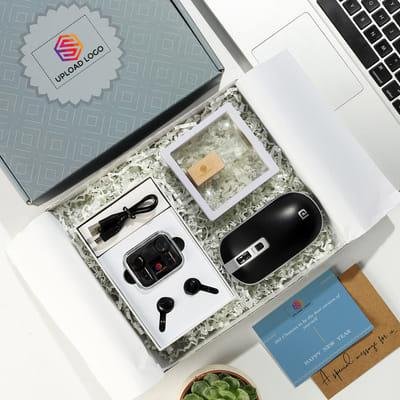 A recurring reward system gives the program a little continuity. The categories named in the raw content are Best Team Player, Most Creative, Quiz Champion, Funniest Performance, Problem Solver, and Friday Champion. Those titles give employees something to look forward to beyond the activity itself.
The article also keeps the reward logic practical: earbuds, power banks, smartwatches, portable speakers, and headphones all show up again, along with the note that the right choice depends on budget and employee preference. That’s really the heart of it. A good reward doesn’t have to be expensive. It just has to feel like something people would genuinely use.
For teams that like recognition, this can become the piece they remember most. The game creates the moment, but the reward gives it a little staying power.
The questions below come from the smaller doubts readers usually have after they’ve already accepted the basic idea and want the format, reward, or participation details sorted out.
Q: What is the easiest Fun Friday activity to run at work?
Two Truths and a Lie, Pictionary, and Charades are the simplest because they need almost no setup. If you want something even lighter, the one-minute challenges fit into the day without taking over the schedule.
Q: What are good rewards for Fun Friday games?
Practical tech gifts work best here: earbuds, power banks, smartwatches, portable speakers, and headphones. The article’s point is that the reward should be useful enough that employees actually keep using it.
Q: How do you make Fun Friday work for remote teams?
Use online quizzes, virtual Pictionary, emoji guessing games, virtual scavenger hunts, or a remote version of Two Truths and a Lie. The idea is to preserve interaction, even if the team is spread out.
Q: What should HR avoid when planning Fun Friday activities?
Don’t make every Friday feel bigger than the last one, and don’t force everyone into the same kind of activity. The article is clear that participation matters more than making people perform.
Fun Friday activities for employees work best when they are simple, social, and easy to repeat, with a useful reward at the end instead of something generic and forgettable.
If the goal is better engagement, start with one game, keep the format light, and choose rewards people can actually use in everyday life.
